316L stainless steel contains molybdenum, offering superior resistance to corrosion and pitting caused by chlorides and harsh chemical cleaning agents, making it ideal for pharmaceutical and high-purity applications compared to 304.
We provide material test reports (MTR/EN 10204 3.1) upon request, confirming chemical composition and mechanical properties that meet 3A, DIN, and ISO standards.
Standard internal surface finish is polished to Ra ≤ 0.8 µm, and mechanically polished or electropolished down to Ra ≤ 0.4 µm for high-purity requirements.
EPDM is best for hot water and steam; Silicone provides high flexibility and hygiene for pharmaceuticals; Viton offers excellent chemical/heat resistance; PTFE provides superior chemical resistance across extreme temperature ranges.
Yes, all rubber and synthetic seals (EPDM, Silicone, Viton, PTFE) used in our valves and fittings comply with FDA 21 CFR 177.2600 / 177.1550 standards.
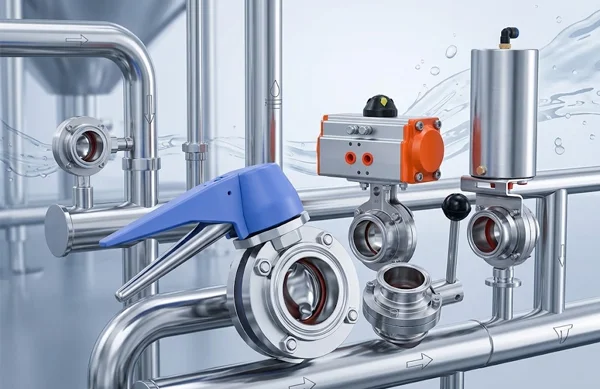
Welding butterfly valves are permanently welded into the piping system to prevent leakage, while Tri‑Clamp butterfly valves allow for quick assembly, disassembly, and easy maintenance.
A multi-position gripper handle allows operators to manually regulate and lock flow rates precisely at various intermediate angles.
It utilizes compressed air driven by a pneumatic actuator (single or double-acting) to automatically open or close the valve horizontally, suitable for automated processing lines.
Yes, they feature smooth internal contours without dead legs, allowing seamless Cleaning-In-Place (CIP) and Sterilization-In-Place (SIP) routines.
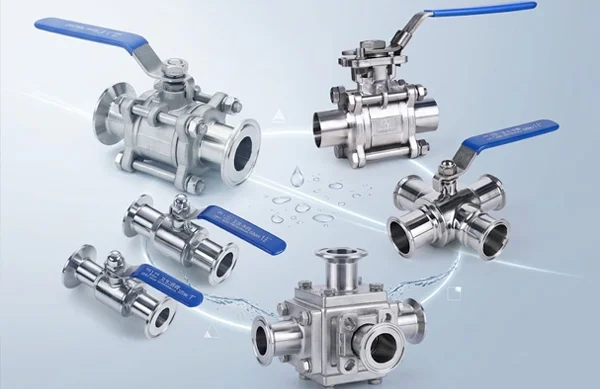
A full bore (full port) ball valve has an internal opening diameter equal to the pipe size, ensuring minimal flow restriction and zero pressure drop across the valve.
Encapsulated seats fill the space around the ball, eliminating internal gaps where media could pool, bacteria could grow, or cross-contamination could occur.
Available in L-port or T-port configurations, it allows flow direction switching, mixing, or diverting between three different pipeline ports.
Diaphragm valves isolate the operating mechanism completely from the fluid path, eliminating contamination risks and providing tight sealing even under frequent sterilization.
It relies on spring pressure or fluid backpressure to automatically seal when flow reverses, protecting upstream equipment from reverse contamination.
It provides a safe and sanitary way to extract fluid samples directly from pipelines or storage tanks without interrupting the main process or contaminating the batch.
The design orientation varies: Straight strainers suit inline piping, Angle‑type strainers fit 90‑degree turns, Y‑type handle high‑flow particulate removal, and R‑type strainers offer compact spaces with easy basket removal.
Mesh screens should be inspected and cleaned regularly based on differential pressure readings across the strainer or during routine maintenance cycles.
It is a Y‑shaped welded fitting designed to split or merge process flows smoothly at an angle, minimizing turbulence compared to standard 90‑degree tees.
21MP translates a Tri‑Clamp connection to a Male NPT thread, while 22MP translates a Tri‑Clamp connection to a Female NPT thread for interfacing with standard industrial piping.
It transitions the connection size between a larger or smaller pipe diameter and a standard Tri‑Clamp ferrule flange.
They transition thin‑wall sanitary Tri‑Clamp tubing system layouts to heavy‑wall Schedule 10S industrial welded pipe lines.
Blind caps temporarily or permanently terminate a clamp connection line end while maintaining a clean, easily removable seal.
High‑pressure 13MHP clamps utilize bolted closures capable of handling significantly higher pressure ratings and thermal spikes compared to wing‑nut single‑pin 13MHM clamps.
A 3‑segment clamp provides 360‑degree uniform compression along the ferrule flanges, ensuring optimal seal compression and extra safety for critical applications.
Pipe holders support heavy line runs, reduce line vibrations caused by pump surging, and maintain pitch for self‑draining systems without corroding or damaging pipe walls.
It consists of a sanitary hose barb with an outer crimping collar, permanently crimped onto flexible hoses to handle high pressures without leaking or detaching.
Sight glasses provide visual inspection of fluid clarity, color, liquid levels, or bubble presence inside sealed sanitary processing pipelines.
It integrates a heavy‑duty tempered glass window with an attached waterproof LED lamp to illuminate and inspect the interior of large process tanks or vessels.
High‑borosilicate glass or toughened tempered glass is standard to withstand high temperatures, thermal shock, and chemical exposure.
Fixed balls spray cleaning media in a set pattern using stationary jets; rotary balls rotate under fluid pressure to provide dynamic, high‑impact 360‑degree coverage using less water and chemical solution.
Non‑pressure manholes are installed at the top of non‑pressurized atmospheric storage tanks for manual ingredient dosing, ventilation, or maintenance access.
Pressure manholes are engineered with heavy locking bolts and thick neck walls to safely seal processing tanks operating under positive pressure or vacuum conditions.
It is an ergonomically designed rectangular side‑entry access cover featuring twin‑arm locking mechanisms for secure seal pressure distribution on processing vessels.
Leaks are typically caused by misaligned ferrules, over‑tightened wing nuts distorting the gasket, damaged gasket sealing faces, or using incorrect gasket material for system temperature/pressure.
Wing nuts should be hand‑tightened until snug, then given an additional quarter to half turn with tools if necessary. Over‑tightening crushes gaskets and causes seal failure.
Yes, as long as they follow standard dimensional specifications (e.g., 3A, SMS, ISO, DIN), Tri‑Clamp ferrules and gaskets are universally compatible.
Lines should be installed with a continuous slope (typically 1/8" per foot / 1%) toward drain valves, and valve stems should be angled correctly to prevent fluid trap areas.
No. EPDM rapidly swells and degrades when exposed to oils, fats, or hydrocarbons. Use Viton (FKM) or PTFE gaskets for oil‑bearing products.
Abrasive particulate matter, cycling above pressure ratings, operating at temperatures exceeding elastomer limits, or cleaning with incompatible chemical agents can ruin valve seats.
Replacement frequency depends on cycle rates, temperature fluctuation, and chemical exposure, but visual inspection during routine CIP checks and annual preventative replacement is recommended.